|
|
Wide Views, Panoramas and VR | |
|
All images copyright Alan Cole 2008 |
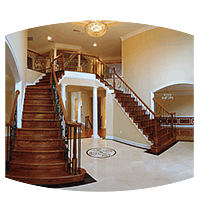
Some times there just isn't enough room to back up. Hollywood builds a house set with no front wall and shoots away, but my assignment was a staircase in a home on the east coast and the wall wasn't budging. | |
|
After hours setting manual points in PanoTools and more hours taking the best of the mediocre output I finally had the image I was looking for, but at a much higher price than I was willing to pay. I looked around for the solution and found the panorama head market segment and talk of things like the entrance pupil. The short of it is that I decided that the new Nodal Ninja 5 was the my best bet. It gave me the ability to mount a wonderfully heavy, bulky D2X body, which was a capability missing from their earlier, lighter, well-reviewed and less-expensive NN3. Still, the NN5 seems to be at a good value point among the competition, especially given the obvious quality of the machining, its precise fit & finish and overall smoothn operation. Here is the result of my first two hours sighting in my Nodal Ninja 5 and then throwing my first 10-frame sequence into PTgui. The coat tree even stands right where it was to help me sight in the NN5 using the edge of the coat tree and the lower cone of the ceiling fan as references to adjust the camera on the top arm of the NN5. There is a little mismatch going on here that I hope to fine tune away with some more NN5 adjustment. Look in the center of the top of the opening on the left; the right side shifts up a bit. The baseboard to the left of the right-hand opening shifts down a bit to the right of center. This is exactly what I bought the panorama head to eliminate, so I hope that both it and I are up to the challenge. I also couldn't resist trying out the great VR that it seems like most everyone but me is doing, so threw PTgui's .jpg output into PTViewer 2.8. It took several more hours looking for and reading the PTViewer documentation and experimenting with the settings to limit tilt and pan to my less-than-360-degree pano, but worth every minute. Thanks to Fulvio Senore for his continued improvement of Helmut Dersch's PTViewer, and to Herr Dersch for his work developing and offering it under GNU General Public License. Also thanks to Signor Senore for leaving the HTML viewable in his example as a guide to exactly how to embed PTViewer into a page. Lots of experimentation to go, like adding the nadir images for the real VR experience, and determining whether it's worth doing the HDR work in Photomatix Pro and then bring the TIFFs into PTgui, or if PTGui Pro is robust enough in its HDR capability. I've been happy using Photomatix in the past with images like these. I can't wait to do a shoot like these interiors and turn out the results in HDR-VR.
|
||
|
Technical Info
|
|
|